
Twenty stages.
Each with its own layout, light, silhouette and sound. Agent Theatre reads what your repo is and suggests the ones that suit it.
Agent Theatre turns a Claude Code session into an animated scene. Your repo becomes a stage. The agent becomes a character. Every read, edit and test becomes a beat.
Folders are districts. Files are buildings. Test files are beacons. The agent walks to what it reads, builds on what it edits, runs the tests at the beacons — and chases gremlins when they fail.
Each with its own layout, light, silhouette and sound. Agent Theatre reads what your repo is and suggests the ones that suit it.
The lead is chosen per repo. Subagents arrive at the dock as other members of the cast.
Every motion is eased. A test in the repo makes sure none sneak in.
Every sound is synthesized at runtime. Every stage has its own voice and ambience.

Long soft shadows, ambient occlusion, rim light, aerial haze, cloud shadows drifting over the ground. Bloom only where something glows.
New in 1.6
A long agent session touches dozens of files. Some it reads, some it edits, some it creates or deletes with a shell command. Agent Theatre now maps all of it.
Reviewing an agent's work meant scrolling a transcript or reading git diff file by file, and you still couldn't tell the agent's edits from yours, a formatter's, or a teammate's.
“Show me which files the agent touched, so I know what changed at a glance, before I review or commit.”
A map of every file the agent touched: by folder, sized by lines changed, coloured new, edited, deleted or read. Checked against git, so shell edits are confirmed on disk and mid-session commits still count.
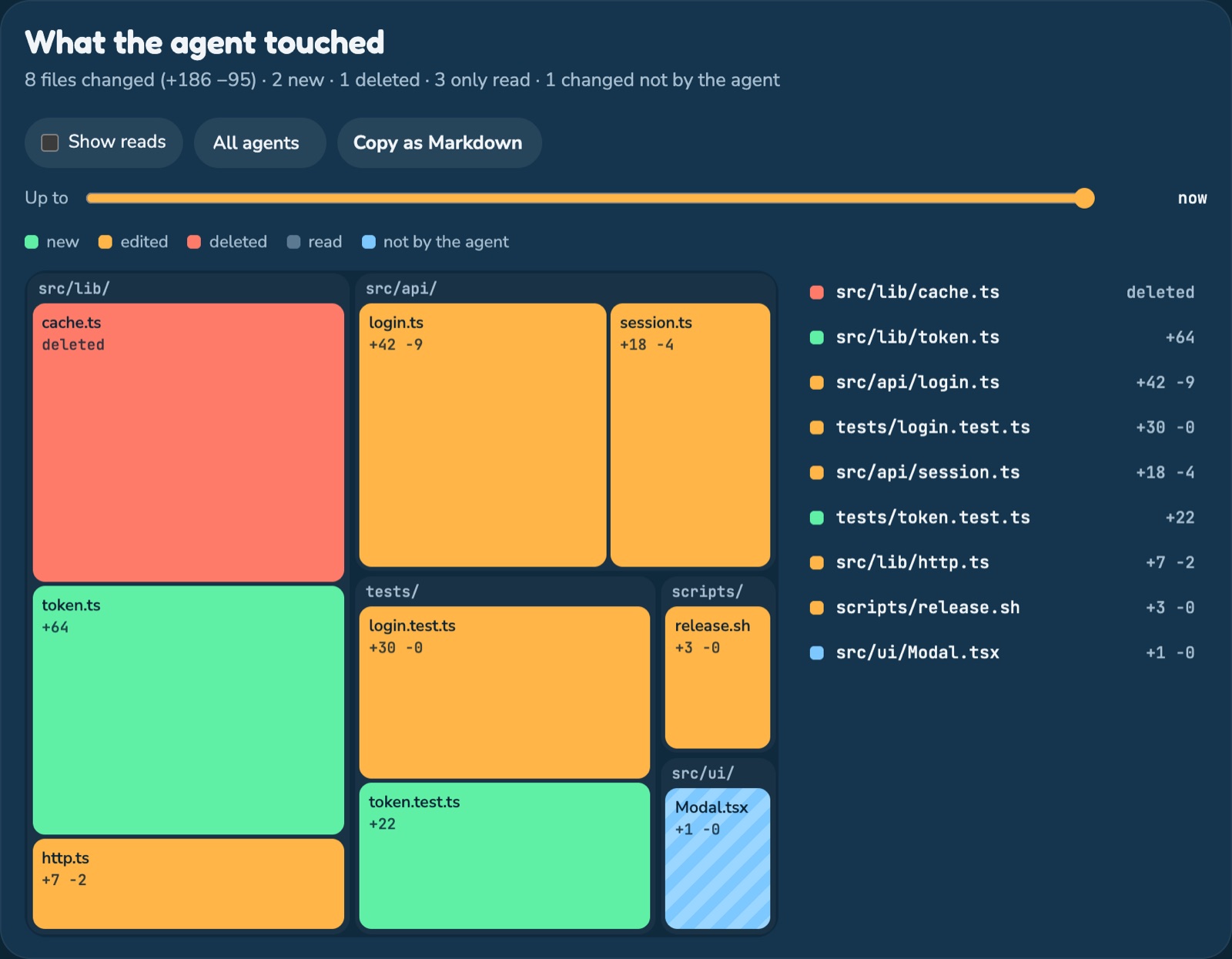
Claude Code shows a one-line summary under the reply: this turn: 3 files changed (+50 −2) · 1 new · 1 deleted, with a link to the map.
Press Changes. Drag the time slider to any moment, filter to one helper, click a file for its diff, copy it all as Markdown.
An Agent changes list in the Explorer, a dot on every file the agent touched, and the editor's own diff on click.
npx agent-theatre changes --pr posts the map as one comment, with your own gh login, after asking you.
Local, like everything else: paths and line counts only. A file's diff is read from your disk only when you open it.
Research, a new feature, a bug fix, a refactor, a deploy, a team of helpers — each a different repo on a different stage. Every one is synthetic: hand-written, never a captured session.

A 15-minute session drop. Two failing tests, one grace window, a green run — and the evidence chip to prove it.

Four field notes, a data file, two web searches, one written brief. No tests to pass, so none claimed.

Two new buildings rise, a route is wired, the suite is green first time.

Six files touched, one test catches a slip, fifty-eight pass.

All shell work at the forge: build, plan, a timeout, a retry, a rollout, a tag.

Two helpers arrive at the dock and fan out while the lead keeps working.

Agent Theatre checks the claim against the evidence: it shows the passing test count as a chip when it exists, and the gremlin when it doesn't. Nothing is invented; every beat traces back to an event.
The same project is a ring island in one set and a terraced spine in another — and always the same in the same set. Scroll, then open any of them.
 IslandA warm little island at golden hour.
 OrbitA quiet station turning above a blue planet.
 MetropolisA warm night city, lights just coming on.
HarbourFog lifting off a working port.
 ObservatoryA mountaintop under a hard, clear sky.
 GreenhouseGlass, leaves and warm afternoon light.
 WorkshopA village of makers, sawdust in the air.
 ArcadeNeon rain on a late-night strip.
 KingdomStone walls, banners, a river below.
 OutpostA desert station at dusk, dust in the light.
 SnowfieldBlue hour, fresh snow, chimney smoke.
 CanopyTreehouses strung through an old forest.
 LagoonTurquoise shallows and white sand at noon.
 VolcanoBlack rock, red sky, light from below.
 CloudtopA floating town above a sea of cloud.
 ReefUnderwater, where the light comes in ribbons.
 BazaarOchre walls, striped awnings, late light.
 MonasteryMist on the mountain, a bell somewhere.
 MoonbaseGrey dust, black sky, one blue marble.
LanternsA night festival, paper light everywhere.
Every character is drawn by one procedural routine from a short spec — a shape, a topper, a pair of eyes, a palette. No sprite sheets. Their light shows their mood.


Claude Code hooks (live) or the session transcript (replay), normalised into one small schema: read_file, edit_file +n −m, run_command, test_result, subagent_start… Counts and paths. Never contents.
The file tree becomes a deterministic arrangement — six layouts, chosen from the repo and the stage. Every file the session touches is always placed.
Events become beats — walk, read, build, run tests, spawn gremlin, chase, celebrate — with a mood: curious, focused, lost, happy.
Isometric WebGL. The camera follows the character; the whole stage appears only to open, celebrate and close, so it never gets cluttered. prefers-reduced-motion respected.
Agent Theatre runs entirely on your machine and talks only to 127.0.0.1. Events carry repo-relative paths, line counts, a command's first word and a classified intent — never file contents, prompts, command bodies or search queries. A test plants marker strings in all of those and asserts zero leaks. Hooks install non-destructively with a backup, and uninstall byte-for-byte.
$ npx agent-theatre hooks install
$ npx agent-theatre
Opens the stage for the repo you're in. Run Claude Code in another terminal and watch. npx agent-theatre replay plays back any past session. Node 22+.
npx agent-theatreCLI · live and replay
Claude Code plugin/plugin install agent-theatre --marketplace shreyassaw5394/agent-theatrehooks + a /theatre command + a skill, one step
Homebrewbrew install shreyassaw5394/tap/agent-theatremacOS and Linux
VS CodeExtensions → search "Agent Theatre"on the Marketplace; .vsix on every release too
Cursor · Windsurf · VSCodiumInstall from VSIXdownload agent-theatre.vsix from the latest release → Extensions → ⋯ → Install from VSIX. Open VSX listing coming
Cursor (MCP)one clickadds the agent-theatre MCP server: open_stage, replay_session, stage_status
VS Code (MCP)one clickCopilot agent mode gets the same tools
Windsurf · Claude Desktop · Codex · Gemini CLInpx agent-theatre initregisters the MCP server with every agent on your machine
Just watchagenttheatre.devsix episodes, no install
MIT. Core, CLI, renderer, the VS Code extension, the plugin and this site in one repo. github.com/shreyassaw5394/agent-theatre · Discord for questions and stages worth showing off.
Runs on your machine, talks only to 127.0.0.1. Paths and counts, never contents or prompts — a test plants secrets in every field and asserts zero leaks.
LastSearch for research with evidence. Debug Anything for runtime observation. Agent Theatre for watching the work. One Discord for the whole suite.